Saying the Rosary Well

St. Louis De Montfort is known as one of the principal advocates for devotion to Our Lady. In his book The Secret of the Rosary he outlines how to say the Rosary well and warns against common mistakes made while saying the Rosary. This passage in particular is worthy of note:

It is really pathetic to see how most people say the Holy Rosary – they say it astonishingly fast and mumble so that the words are not properly pronounced at all. We could not possibly expect anyone, even the most unimportant person, to think that a slipshod address of this kind was a compliment and yet we expect Jesus and Mary to be please with it! Small wonder then that the most sacred prayers of our holy religion seem to bear no fruit, and that, after saying thousands of Rosaries, we are still no better than we were before! Dear Confraternity members, I beg of you to temper the speed which comes all too easily to you and pause briefly several times as you say the Our Father and Hail Mary…

To see a Saint use the words pathetic and slipshod gives a clear indication of how little patience he has with poorly said prayers. Some have argued that it does not matter how fast you say the prayers of the Rosary, as long as you are meditating on each mystery. While it is true that meditation is the primary goal of the Rosary, we cannot forget that this prayer is made up of the Angelic Salutation. Every Hail Mary is a salutation to the Mother of God, and should be said respectfully.

Additionally, the point of the Rosary should never be to finish as quickly as possible. Saying each Hail Mary and Our Father slowly and deliberately has at least two practical benefits:

  1. When we become distracted or find it difficult to meditate, focusing on the words of these beautiful prayers helps us to re-engage our meditation, or even provides a means of meditation themselves.
  2. The slower we say the words, the more time we have to meditate.

This does not necessarily mean the Rosary should be said at a snail’s pace. Recently, our parish priest gave some instruction on this topic and said, very practically, that the Rosary (especially in group settings) should be said at a conversational pace. Though this will vary from person to person, it is a good general guideline.

God Bless

The Structure of the Rosary

St. Louis de Montfort was the author of a beautiful book: The Secret of the Rosary. In it, he expounds upon (among other things) the reasons for the Rosary to be divided into sections as it is. I thought these were beautiful enough to share:

Ever since Saint Dominic established the devotion to the Holy Rosary up until the time when Blessed Alan de la Roche re-established it in 1460 it has always been called the Psalter of Jesus and Mary. This is because it has the same number of Angelic Salutations as there are psalms in the Book of the Psalms of David…

Our Lady’s Psalter or Rosary is divided up into three parts of five decades each, for the following special reasons:

  1. To honor the three Persons of the Most Blessed Trinity;
  2. To honor the life, death and glory of Jesus Christ;
  3. To imitate the Church Triumphant, to help the member of the Church Militant and to lessen the pains of the Church Suffering;
  4. To imitate the three groups into which the Psalms are divided:
    1. the first being for the purgative life,
    2. the second for the illuminative life,
    3. and the third for the unitive life;
  5. And, finally, to give us graces in abundance during our lifetime, peace at death, and glory in eternity.

He makes it clear that the connection between the 150 Davidic Psalms, and the 150 angelic salutations is extremely important to the Rosary and is why it is referred to as the Psalter of Jesus and Mary.

This seemed to be a good follow up quotation from my previous post on the origin of the Rosary

God Bless

On the Brown Scapular

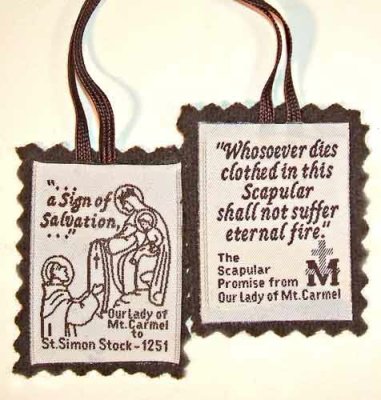
scapulars

I’ve been enrolled in the Brown Scapular for many years now. During this time I’ve heard not a little confusion on the promises attached to the Scapular, along with what is necessary to obtain them. This prompted me to recount a short history and detail of the Brown Scapular devotion with the merits and graces attached to it.

Saint Simon Stock

St. Simon Stock is the man known to have received the Brown Scapular from Our Lady. At the age of 12, St. Simon retired to a forest where he lived in the trunk of a tree for 20 years as a hermit. As a tree-trunk was another word for “Stock”, he became known as Simon Stock. Not long after his period of isolation, he joined the Carmelites, eventually to become Superior-General of the order.

In 1251 St. Simon Stock received an apparition from the Mother of God in which she was holding the full scapular of the Carmelite order. Her words to him were “Receive, my beloved son, this habit of thy Order: This shall be to thee and to all Carmelites a privilege that whosoever dies clothed in this shall never suffer eternal fire.” The Carmelites, as part of their orders habit, wear a long (sometimes nearly floor length) brown cloth around their shoulders. This was the Scapular given Our Lady to the Saint. St. Simon’s confessor (Father Peter Swanington) writes of having accompanied the Saint on the same day of the apparition to the house of a man possessed, where the Saint healed him using his own Scapular.

Over the years, for laymen to practically wear the Scapular, it was significantly reduced in size. It is a common practice in the Catholic Church for those laymen who wish to be associated with different orders to join Confraternities. The Carmelites established the Confraternity of Our Lady of Mount Carmel to allow individuals to wear and receive the benefits of the Brown Scapular. Pope Urban IV proclaimed indulgences and favors for this Confraternity. To receive the full graces and indulgences of the Brown Scapular, one must be enrolled in the Scapular by a priest. After one has been enrolled, it is for life, and there is no need to have any new Scapulars blessed if your original gets lost or damaged and must be replaced.

The Sabbatine Privilege 

Pope John XXII, issued a Papal Bull on March 3, 1322 attaching to the Brown Scapular the promise of early liberation from Purgatory if three conditions were fulfilled:

  1. The Brown Scapular of Carmel must be worn with constancy.
  2. One must observe chastity according to one’s state in life.
  3. The Little Office of Our Blessed Mother must be recited daily.

Since the last requirement is difficult for laymen to fulfill, the Church has allowed the observance of the ordinary fasts of the Liturgical Year along with abstaining from meat on Wednesday and Saturdays in place of the office. More recently the daily Rosary has also become an alternative, when approved by one’s confessor.

Our Lady has revealed to Venerable Dominic of Jesus and Mary:

Although many wear my Scapular, only a few fulfill conditions for the Sabbatine Privilege.

Let us make sure we are one of the few!

Proper Wearing of the Scapular

The Scapular must be warn over the shoulders in such a manner that one part hangs in front of the body and the other part hangs in back. Wearing it in any other way does not carry any indulgence or promise. In addition, the Pope has declared that the Scapular Medal should not be worn in place of the Cloth Scapular without sufficient reason. Originally the Scapular Medal was allowed to overseas missionaries who were in such a damp, humid climate that they could not keep their Scapulars from falling apart.

Wearing the Brown Scapular constantly and with an awareness that it is the garment of Our Lady is, by itself, most often neglected by those who would assume they are to receive the Sabbatine privilege. In short, wearing the Brown Scapular properly must be a very intimate part of our spiritual life. Not only must we wear it with constancy, but we must remain chaste according to our station in life. How many, in our society today, struggle with that?

However, those good Catholics who wear the Scapular and observe chastity according to their station in life still must have a daily devotion to Our Lady to fulfill the requirements for this promise. It seems very appropriate that such a great promise is attached to a constant, daily devotion to Our Lady, and not just a one-time enrollment.

The Power of the Scapular

St. Claude de la Colombiere was the spiritual directory of St. Margaret Mary he said of the Brown Scapular:

Because all the forms of our love for the Blessed Virgin, all its various modes of expression cannot be equally pleasing to Her, and therefore do not assist us in the same degree to Heaven. I say without a moments hesitation that the Brown Scapular is the most favored of all.

Saints Don Bosco and Alphonsus Ligouri were both very dedicated to Our Lady of Mount Carmel and wore the Brown Scapular. When their graves were opened years after death their Scapulars found to be completely intact. The Scapular of St. Alphonsus Ligouri is still on exhibit in his monastery in Rome.

Our Lady of Fatima, during her last apparition, appeared Our Lady of Mount Carmel holding the Brown Scapular out to the world. In times of trial and temptation, what better way to call to heaven for help than to wear the garment of Our Lady?

God Bless.


The Origin of the Rosary

The rosary is a powerful prayer and one of the most potent weapons of the Catholic faith against heresy and error. Sadly, though many Catholics are devoted to the rosary and its daily recitation, few know about it’s beautiful history and origin. As such, I thought it would be a valuable lenten exercise to learn a little about the history of this prayer and share it. What follows is a very brief and concise history.

From the early ages of the Church, the 150 psalms were recited by its laity. Monks would recite all 150 of these either daily or weekly and, as these are the Davidic psalms, this is knows as Psalter of David. Those who could not read, or did not have a copy of the scriptures to read were unable to join in these prayers and would substitute either 150 Paters or Aves instead.

By the 11th century, Christians, out of love for Our Lady, were starting to compose Rosariums in her honor. The word Rosarium means “a garden of roses” in Latin. These were psalms composed to praise Mary, and each was offered as a spiritual rose to Our Lady. From what I can tell, there was not a consistent set of these, many composed their own. In the 13th century, St. Bonaventure divided his 150 Marian Psalms into three groups of 50. These Rosaries took the name Our Lady’s Psalter.

What is commonly known is that the Rosary, in its current form, was spread by St. Dominic through his order, the Dominicans. In the 13th century, Our Lady appeared to St. Dominic referring to the Angelic Psalter as the battering ram to be used in the kind of warfare currently hampering the Church. St. Dominic was fighting the Albigensian heresy, and had spent three days imploring heaven for help in converting those spreading its error. St. Gabriel’s greeting to Our Lady in the first chapter of Luke is known as the Angelic Salutation, the prayers we currently know as simply the Hail Mary.

Though there does not seem to be a detailed account of the institution of the current form of Rosary by St. Dominic,  it is widely traced to the Dominican order, and thus St. Dominic himself.

Throughout the centuries the Popes often referred to the Rosary as the Psalter of Mary. Commonly, the Psalter of Mary was known as the entire 150 prayers, while the word Rosary was applied to a section of the prayer. St. Pius V in his Consueverunt Romani in 1569, in response to the current immorality facing the Church, wrote:

the inspired Blessed found of the Order of Friars Preachers in circumstances similar to those in which we now find ourselves… raised his eyes up unto heaven, unto that mountain of the Glorious Virgin Mary, loving Mother of God…

And so Dominic looked to that simple way of praying and beseeching God, accessible to all and wholly pious, which is called the Rosary, or Psalter of the Blessed Virgin Mary, in which the same most Blessed Virgin is venerated by the angelic greeting repeated one hundred and fifty times, that is, according to the number of the Davidic Psalter…

Interposed with these prayers are certain meditations showing forth the entire life of Our Lord Jesus Christ, thus completing the method of prayer devised by the Fathers of the Holy Roman Church.

(Read Consueverunt Romani in its entirety here)

This was written just before the battle of Lepanto in 1571, in which the Christian armada, led by Don Juan of Austria, defeated the Muslim forces in a decisive naval victory, obtained by the intercession of Our Lady through the power of the Rosary.

What is also interesting about this words of St. Pius V in his encyclical is his reference to the meditative part of the Rosary. I have often heard the discussion around me of whether one should concentrate on the mystery or the actual words of the Hail Mary. Separately from the human difficulties of concentrating on a single prayer 50 times when saying a third of the Rosary, it is obvious that the meditative aspect of the Rosary is what makes it a complete prayer.

Also of note is the strong importance of the number of Hail Mary’s in the Rosary – 150. This is why it is referred to as a Psalter and why it was prayed originally. This is also why the inclusion of the Luminous mysteries pose such a problem. With another set of mysteries comes another 50 Hail Mary’s, bringing the total to 200. This is no long a Psalter at all. In addition, it makes the request of Our Lady of Fatima (to pray a third of the Rosary every day) very difficult. One third of 150 is the common 5 mysteries accompanied by 10 Hail Mary’s whereas one third of 200 is a very uneven number.

The Rosary is truly a gift from heaven. Knowing its origin and some of its history should give us all a much deeper appreciation for it, and should help us all to cherish it and unite our thoughts and prayers with Christians from the past who simply wished to give Our Lady a spiritual rose.


Some of the resources I came across while reading and were used in writing this post:

Dressing Well in Mass

Something I was curious about, so I have been browsing some interesting links about proper attire in mass and for every day life.

https://www.catholicgentleman.net/2013/07/gentlemen-dress-up-for-mass/

https://www.catholicgentleman.net/2015/04/dressing-like-a-man-for-mass/

http://www.catholicapologetics.info/morality/modesty/dress.htm

http://sspx.org/en/news-events/news/how-catholics-ought-dress-2203